Charles—Constance
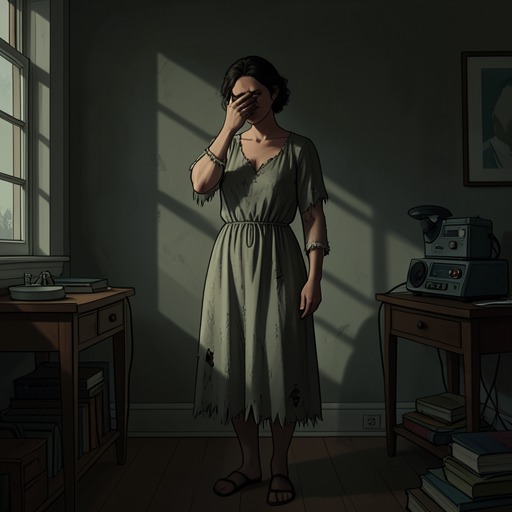
We Have Always Lived in the CastleCharles Blackwood and Constance Blackwood are cousins whose relationship shifts from Charles’s attempt to establish authority in the Blackwood home to Constance’s final refusal to admit him. His pressure takes hold in small domestic decisions as well as open quarrels: he demands that Constance discipline Mary Katherine and restore order to his room, while Constance repeatedly tries to calm him. The change comes not through reconciliation but through separation. When Charles returns after Julian Blackwood’s death, Constance listens from behind the closed door and lets him leave without a reply.
Cousins and the household past
Their kinship places Charles inside the family, but does not make him one of the household’s trusted keepers. He identifies himself as the sisters’ cousin and recalls having visited before. During his stay, however, his claim to belonging increasingly collides with the routines and inherited objects around which Constance’s domestic life is organized.
The family’s earlier crisis casts a shadow over that household without establishing Charles’s part in it. After the Blackwood family poisoning, Constance had washed the heavy silver sugar bowl before the doctor or police arrived, explaining that there had been a spider in it. Helen Clarke later points to the washing and to Constance’s failure to summon a doctor as suspicious circumstances. These recollections concern Constance’s past and the family’s damaged standing; they do not show Charles participating in the poisoning. They do, however, make the house’s objects and domestic practices carry a weight that exceeds their ordinary use.
Charles presses for control
The conflict becomes explicit when Charles demands that Mary Katherine explain the disorder in his room. Constance is not the person he is addressing, but she responds as though she must repair the situation and keep his anger from escalating. When Charles turns to her, he insists that she should get out of the dispute and implies that she would be better off away from the house. Constance answers by taking responsibility for the trouble and offering to clean his room, even though Mary Katherine will not answer him.
That appeasement is visible in what Constance does next. Once Julian Blackwood asks for lunch, she moves to the table, sweeps away the dirt and leaves Charles has left there, gathers them into a paper bag, and scrubs the surface. Her return to familiar kitchen work contrasts with Charles’s demand that the household respond to his grievance. She tells him to rest until lunch; he refuses to go anywhere until something is done about Mary Katherine. Constance replies that she has already offered to clean his room. Her care and ordinary routine do not resolve the quarrel, but they briefly displace its terms.
The objects in Charles’s room make the conflict concrete. Family saucers, kept on the pantry’s top shelf because they had been used and replaced across generations, have been distributed around the house; one lies in the bedroom beneath his burning pipe. Mary Katherine brushes the saucer and pipe from the table into a wastebasket. The episode links Charles’s occupation of a room with a disturbance of the household’s rules for where inherited things belong. It does not establish that Constance shares Mary Katherine’s interpretation of the objects, but it shows the domestic disorder around which Charles demands an explanation.
Appeasement and the damaged home
Constance’s effort to keep the peace does not prevent the larger rupture. After the house has been wrecked, she and Mary Katherine enter the kitchen through a doorway blocked by the overturned table. Chairs are smashed; jars, dishes, silverware, and generations of carefully kept household linen are broken, scattered, or torn. Constance recognizes a spoon as part of her grandmother’s wedding pattern, then checks the cellar and finds the preserved food untouched. The destruction belongs to the aftermath of the villagers’ attack, not to a demonstrated act by Charles. Still, the ruined kitchen sharply contrasts with the ordered domestic space in which Constance had tried to meet his demands.
The sugar bowl reappears among the wreckage, its rose handles gone, while Mary Katherine thinks the attackers found the sugar and imagines them mocking the family. Later, the sisters cautiously gather produce from the garden, keeping watch on their barricades and returning to the house if anyone approaches. They are no longer negotiating a shared household with Charles; their daily life is organized around keeping strangers out. This altered setting gives the earlier conflict a lasting consequence: Constance’s home and care remain, but access to them becomes something she can withhold.
The final refusal
Charles’s return makes the change unmistakable. He comes back with a photographer concealed near a car, hoping to persuade one of the sisters to appear at a window. At the front door he calls for Constance, presents himself as a familiar cousin, and asks to put the quarrel behind them. He says he is sorry if he offended her and asks her to open the door. From inside, Constance does not answer. Mary Katherine understands that Constance now sees Charles as a ghost and demon, one of the strangers.
Charles tries another appeal by saying he has visited Julian Blackwood’s grave and left flowers there, recalling Julian as a kind man who treated him well. The appeal invokes a family bond and a shared loss, but it does not open the door. When the photographer grows impatient, Charles descends the steps, gives Constance one last chance to call him back, and leaves in the car. Constance waits until he is safely gone before laughing with Mary Katherine; the sisters embrace in the dark hall, and Constance says she is happy. The relationship ends not with a repaired cousinly intimacy but with a boundary maintained: Charles asks to be readmitted, and Constance chooses the closed house.